Automated SEO is the use of software, usually powered by AI, to carry out the repeating jobs of search engine optimisation on a schedule. That means finding the searches your customers make, writing and publishing optimised articles, linking your pages together, building links and tracking where you rank on Google. It does not replace a sound website or good judgement, but it keeps the routine work happening every week without you doing it by hand.
Most UK businesses know they should be "doing SEO". Fewer have time to research keywords on a Tuesday night, write an article, publish it, link it to the right pages and then check whether it moved anything. The writing alone takes a while: Orbit Media's 2026 survey of 1,042 content marketers found the average blog post takes 3 hours 20 minutes. Automation is designed to close that gap between knowing and doing.
This guide covers what it is, which parts of SEO can sensibly be automated, which cannot, what Google says about it, and how to tell whether it suits your business.
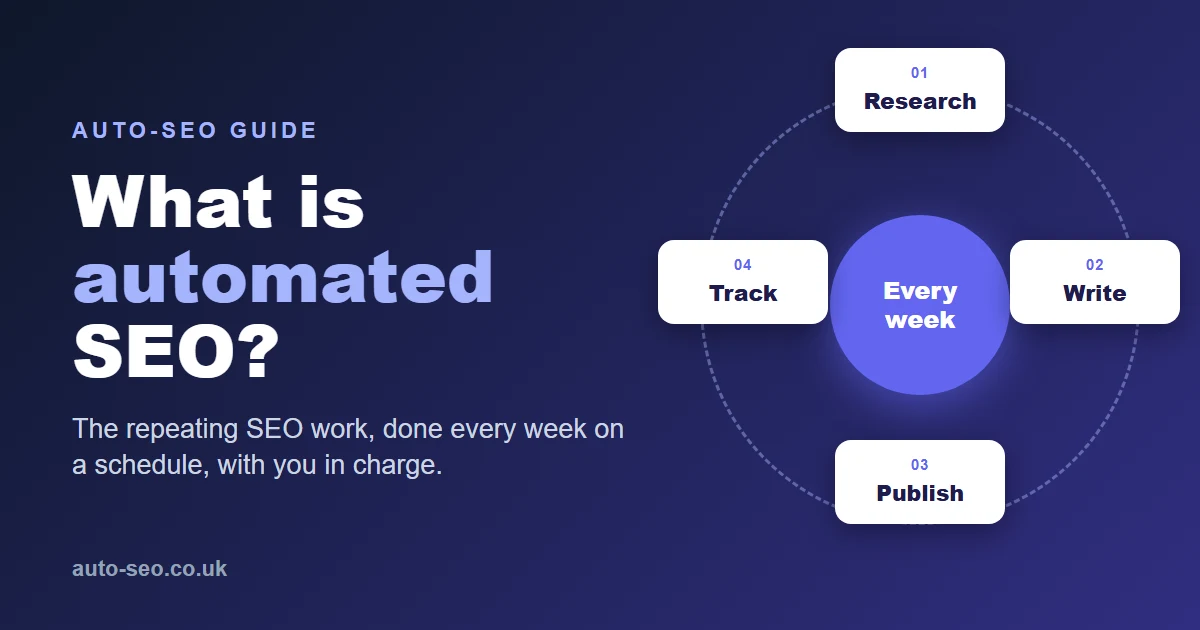
What is automated SEO, in plain English?
Search engine optimisation is a collection of tasks that help your website appear when people search for what you offer. Some are one-off decisions, such as which services to focus on. Many more are repetitive: publishing helpful content, keeping titles and descriptions tidy, linking new pages to old ones and checking your positions.
Search is still central to how people in the UK go online. Ofcom's Online Nation 2025 report found Google Search is used by 82% of UK adults, with around 3 billion searches a month.
Automation hands those repetitive tasks to software that runs on a timetable. Instead of SEO happening in bursts whenever someone finds a spare afternoon, it happens every week. The software does the legwork; you stay in charge of the direction, such as which services matter and which areas you cover.
Search rewards websites that keep adding useful, relevant pages over months, and consistency is the part most businesses struggle with. We look at the right pace in our guide to how often to publish blog content for SEO.
Volume alone isn't enough, though. When Ahrefs analysed around 14 billion pages in 2023, 96.55% got no traffic from Google at all. Targeting searches people actually make matters as much as publishing regularly.
Which SEO tasks can be automated?
Not every part of SEO suits automation, but a surprising amount of the weekly workload does.
Keyword and topic research
Software can look at your website, services and competitors, then suggest the searches worth targeting. Good tools focus on what real customers type, such as "boiler service cost Leeds", rather than vague industry terms.
Writing optimised articles
AI writing models can produce well-structured articles that answer your customers' questions, with clear headings, a short answer near the top and an FAQ section. Titles, meta descriptions, image alt text and structured data can be added consistently too. Quality depends heavily on the facts they are given, which is why the better platforms let you add your own business details for the writer to follow.
Publishing
Articles can go straight to WordPress, Shopify, Wix, Webflow and similar platforms on a staggered schedule.
Internal linking
Each new article can link to related articles and key service pages, helping visitors and Google see which pages matter most.
Rank tracking and reporting
Checking your positions every week is tedious by hand and easy for software, and a ranking graph shows whether the work is moving in the right direction. If one competitor keeps beating you for an important search, Outrank a Competitor compares the two pages side by side.
AI search readiness
AI answers are now part of everyday search. Ofcom found that about 30% of UK searches show AI overviews, and ChatGPT had 1.8 billion UK visits in the first eight months of 2025, up from 368 million a year earlier. Groundwork such as answer-first structure, FAQ markup and making sure AI crawlers are not blocked can also be automated, and our AI Readiness Check tests whether AI crawlers can reach your site. We cover this in more depth in our guide to generative engine optimisation (GEO).
What automated SEO can't do
- It can't guarantee rankings. No reputable provider, automated or human, can promise a position on Google. Anyone who does is guessing.
- It can't know your business better than you do. Software won't know you stopped a service last year or only cover certain postcodes unless you tell it.
- It can't fix a broken website on its own. If your site is very slow, blocks search engines or has serious technical faults, new content will struggle until those are fixed. That is why a technical audit is a sensible first step.
The best set-up is usually automation for the volume work, with a person setting direction and checking accuracy.
Is automated SEO safe with Google?
Google's position is clearer than many people expect. In its guidance on AI-generated content, Google says it rewards helpful, original content however it is produced, and that using automation mainly to manipulate rankings breaks its rules. Its spam policies on scaled content abuse target large volumes of unoriginal pages that add little value for readers.
In practice, automation is safe when it:
- publishes at a steady, sensible pace rather than flooding a site with hundreds of thin pages;
- writes about topics genuinely relevant to the business and its customers;
- uses accurate facts about the business and avoids invented claims;
- lets the business owner review, edit or reject articles before they go live.
It becomes risky when used to churn out near-identical pages for every town in the country. The tool is not the problem; how it is used is.
Automated SEO vs doing it yourself vs an agency
| Doing it yourself | Traditional agency | Automated SEO | |
|---|---|---|---|
| Main cost | Your time | Monthly retainer (the most common band in Ahrefs' 2024 survey of 439 SEO providers was $501 to $1,000 a month) | Monthly subscription (Auto-SEO plans start at £49) |
| Consistency | Depends on how busy you are | Good, within the hours you pay for | Runs every week on a schedule |
| Strategy and judgement | Yours | Strong, from experienced people | Software-led, guided by your input |
| Best for | Owners with time and interest | Complex or high-stakes projects | Businesses that need steady content and tracking without the workload |
These options can work together. For the trade-offs, see our comparison of automatic SEO and manual SEO.
How automated SEO works at Auto-SEO
Auto-SEO is an automated SEO platform built for UK businesses. Here is how it works, step by step:
- Scan and connect. WordPress sites can use our free Auto-SEO Connect plugin, and we also publish to Shopify, Wix, Webflow and other platforms.
- Plan. We identify the searches worth targeting for your services and area. You can add notes or documents to your Knowledge Base, and every article is written with them in mind.
- Write and publish. New articles, with images, internal links and meta descriptions, arrive in your dashboard each week. You approve them, edit them or switch on automatic publishing.
- Build and track. Each plan includes website backlinks every month and a Google ranking graph so you can see how your focus keyphrases are moving.
Plans start at £49 a month for Starter (one article a week), £79 for Growth (two a week, plus GEO and free website hosting) and £129 for Pro (four a week). There are no contracts, and you can see the full breakdown on our pricing page. You can try it for 7 days for £1, which includes your first 3 articles and a free website audit worth £49, so you can see the technical issues on your homepage before any content goes out.
Is automated SEO right for your business?
It tends to suit you if:
- customers search online for the services you offer, locally or nationally;
- you know regular content would help but never find the time to write it;
- you want to see your rankings without logging into several tools.
It may not suit you if your website has serious unresolved technical problems, if every word must be signed off by a regulated professional, or if you want a bespoke campaign run entirely by people. In those cases, start with a full technical website audit or a specialist.
For a longer read, our complete guide to automated SEO for UK businesses goes further into backlinks, tracking and publishing.
Frequently Asked Questions
What is automated SEO in simple terms?
Automated SEO is software that does the repeating parts of search engine optimisation for you on a schedule, such as researching keywords, writing and publishing optimised articles, adding internal links and tracking your Google rankings. You set the direction and the software keeps the work going every week.
Is automated SEO the same as AI SEO?
They overlap. Most automation platforms now use AI to write and optimise content, but automation also covers non-AI jobs such as scheduled publishing, rank tracking and technical checks. AI SEO usually refers to the writing and analysis side.
Will Google penalise automated SEO content?
Not because it is automated. Google says it rewards helpful content however it is produced. Problems come from publishing large volumes of thin, unoriginal or inaccurate pages. Steady publishing of relevant, accurate articles, with the option to review them first, keeps you on the right side of Google's guidelines.
How long does automated SEO take to work?
SEO builds over months rather than days. New articles need to be found and indexed, and rankings tend to improve gradually as your site covers more of what customers search for. Results vary by industry, competition and the state of your website, so be wary of anyone promising a fixed timescale.
How much does automated SEO cost in the UK?
Prices vary by provider and by how much work is included. At Auto-SEO, plans start from £49 a month, with a 7-day trial for £1 that includes 3 articles and a free website audit worth £49. There are no contracts.
Want to see what we would focus on for your website? Start your £1 trial with a free website audit and the Auto-SEO team will show you where your site stands before your first articles are written.