Published 30 Oct 2026 · Updated 30 Oct 2026
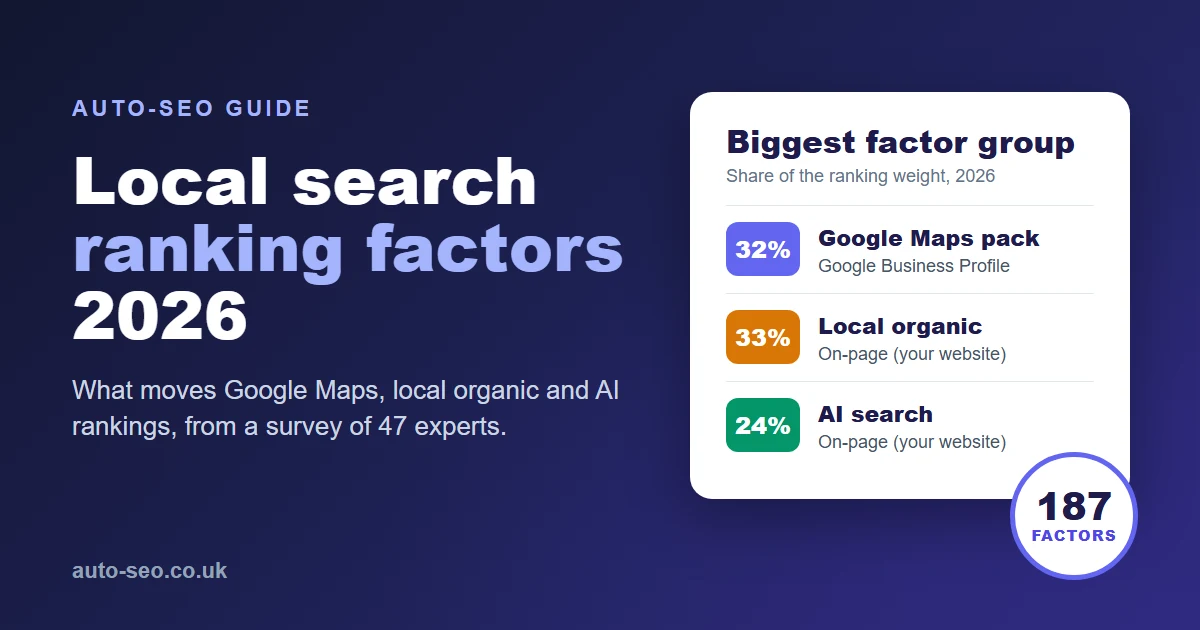
Quick answer: local search ranking factors are the signals that decide which businesses appear in the Google Maps pack, the local organic results and, more and more, AI answers. In Whitespark's 2026 Local Search Ranking Factors survey (Darren Shaw), 47 experts gave your Google Business Profile the most weight for Maps (32%), while on-page signals led for local organic (33%) and AI search (24%). Reviews were the fastest-growing group.
Please note: this survey is expert opinion, not a list Google has confirmed. Treat the scores as a guide to what to fix first, not a promise of rankings.
Key takeaways
Your Google Business Profile drives the Maps pack. It carries 32% of the weight, with reviews next at 20%.
Your website drives the local organic results. On-page signals carry 33% and links 24%.
AI search rewards being talked about. Three of the top five AI factors are about mentions on other sites.
Reviews are rising. A steady flow of recent reviews now counts for more than a big total.
Opening hours matter more than ever. Being open when someone searches is now the fifth-biggest Maps factor.
What is the Local Search Ranking Factors survey?
Whitespark's Local Search Ranking Factors survey asks local SEO specialists to score the signals they believe move local rankings. The 2026 edition, led by Darren Shaw and published on 6 November 2025, collected scores from 47 experts across 187 factors.
It covers the Google Maps pack (the three businesses shown under the map), the ordinary local organic results and, for the first time, visibility in AI search tools. It also scores what makes a searcher choose you, what hurts you and what can get a listing suspended.
What it isn't is Google's own rulebook. Google doesn't publish its ranking weights, so these are informed opinions from people who test local rankings for a living. Each list also uses its own scale, so a score in one list can't be compared with a score in another.
For most UK local businesses, the message is clear: your profile and your reviews do the heavy lifting on Maps. If you'd rather not manage that yourself, our team offers monthly Google Business Profile optimisation to keep it complete and active.
How Maps, organic and AI search weigh each factor group
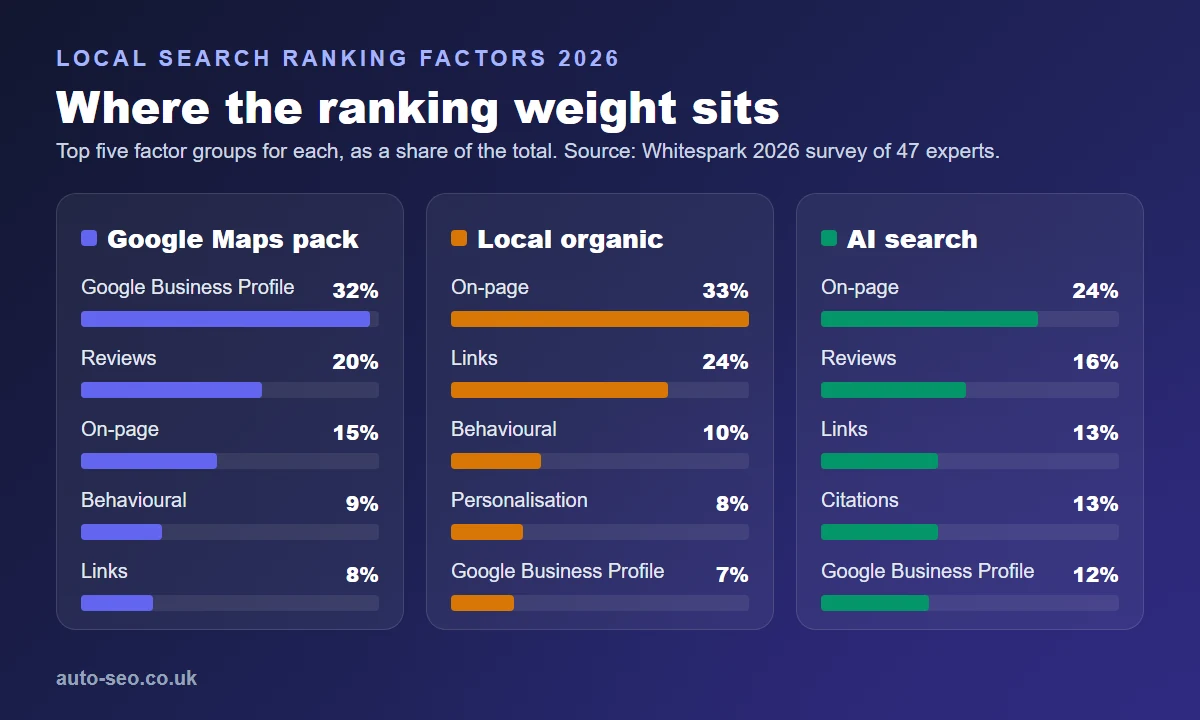
The survey sorts the factors into eight groups and estimates how much each group counts towards each type of result. Here's the split.
Factor group | Google Maps pack | Local organic | AI search |
|---|---|---|---|
Google Business Profile | 32% | 7% | 12% |
Reviews | 20% | 6% | 16% |
On-page (your website) | 15% | 33% | 24% |
Behavioural (clicks and visits) | 9% | 10% | 4% |
Links | 8% | 24% | 13% |
Citations (business listings) | 6% | 7% | 13% |
Personalisation | 6% | 8% | 9% |
Social (back in 2026) | 4% | 5% | 9% |
Three things stand out. Your Google Business Profile dominates Maps but barely registers in the organic results, where your website does the work. AI search spreads its weight more evenly across your website, your reviews and what other sites say about you.
Compared with the 2023 survey, reviews gained the most in the Maps pack, rising from 17% to 20%. On-page signals fell from 18% to 15% and links from 11% to 8%, while Google Business Profile edged up from 31% to 32%.
Google Maps ranking factors: the top 10
These are the ten single factors the experts rated highest for the Maps pack. The number in brackets is the survey's score, and higher means more important.
Primary Google Business Profile category (227). The one category that best describes what you do. Get this wrong and little else helps.
How close your address is to the searcher (225). You can't change this, which is why rankings shift street by street.
Keywords in the business name (223). It works, but Google's guidelines say your profile name must match your real-world name. Adding keywords breaks the rules and risks suspension, so use your genuine trading name only.
A physical address in the town being searched (213).
Being open at the time of search (189). Its highest score yet. As the report puts it, "Google wants to show people businesses that are open."
High Google ratings (181).
Showing your address on the profile (176). Only if customers really visit you. Google asks service-area businesses to hide their address, and Darren Shaw isn't sure this is a true ranking factor anyway.
Additional categories (173). Extra categories that genuinely match services you offer.
The number of Google reviews with written text (170).
Correct map pin placement (165).
Just outside the top ten sit review recency (164), closeness to the centre of the area being searched (157), clicks from the Maps results (156) and a steady flow of reviews rather than sudden bursts (154).
What to do this week: your Maps listing
Check your primary category is the closest match for your main service, and only add extra categories you really offer.
Set accurate opening hours, including special hours for bank holidays, and only list hours you keep.
Fill in Google's predefined services, then add your own custom services with a short description of each.
Open the map and check your pin sits on your actual premises.
Match your name, address and phone number on your website to your profile, word for word.
For a wider checklist beyond your profile, work through our essential local SEO tips for 2026.
What's rising and falling in 2026
The biggest climbers since 2023 are all things you control inside your Google Business Profile.
Keywords in your profile's services: up from around 110th to the mid-30s.
Proper hours on your profile: up from 85th to 21st.
In-store visits via Google Maps: up from 73rd to 41st.
How people engage with your profile: up from 48th to the mid-30s.
New or newly prominent in the Maps list are Google's predefined services (22nd), keywords in your custom service titles (30th) and reviews that include photos (44th). Clicks from the Maps results also stand out, at 13th.
On the way down are links from your profile's landing page to other pages on your site (from 45th to around 110th) and linking out to authority sites (from 113th to 177th). The amount of content on service pages also fell 40 places.
The experts also named long "ultimate guide" pages, guest posting, thin AI-generated blog posts and mass low-quality citation building as losing value. On long guides, one contributor was blunt: "It does not work anymore."
What to do this week: catch the risers
Add your services to your profile in the words customers use, with a sentence on each.
Ask for reviews every week rather than in one big push.
Upload real photos of your work, team and premises. Stock and AI-generated images count against you.
Merge or rewrite thin pages that repeat the same text with only a town name swapped.
Local organic ranking factors: your website's job
For the ordinary results under the map, your website does most of the work. These are the top five organic factors:
A dedicated page for each service (210).
Content that's relevant to your town or neighbourhood (190).
The quality and authority of links to your site (187).
Keywords in the landing page's title tag (179).
Links from sites in your industry (175).
Internal linking across your site comes sixth (174), ahead of many link factors. A mobile-friendly site (154) and HTTPS (154) are still basics in the top 20.
Local relevance means more than adding a town name to every page. Our guide to writing content for local markets shows what real local detail looks like.
What to do this week: your website
Give every main service its own page, with the service and town in the title and main heading.
Add genuine local detail: the areas you cover, jobs you've done nearby and the questions customers really ask.
Link related pages together with clear, descriptive wording.
Check every page works on a phone and loads over HTTPS.
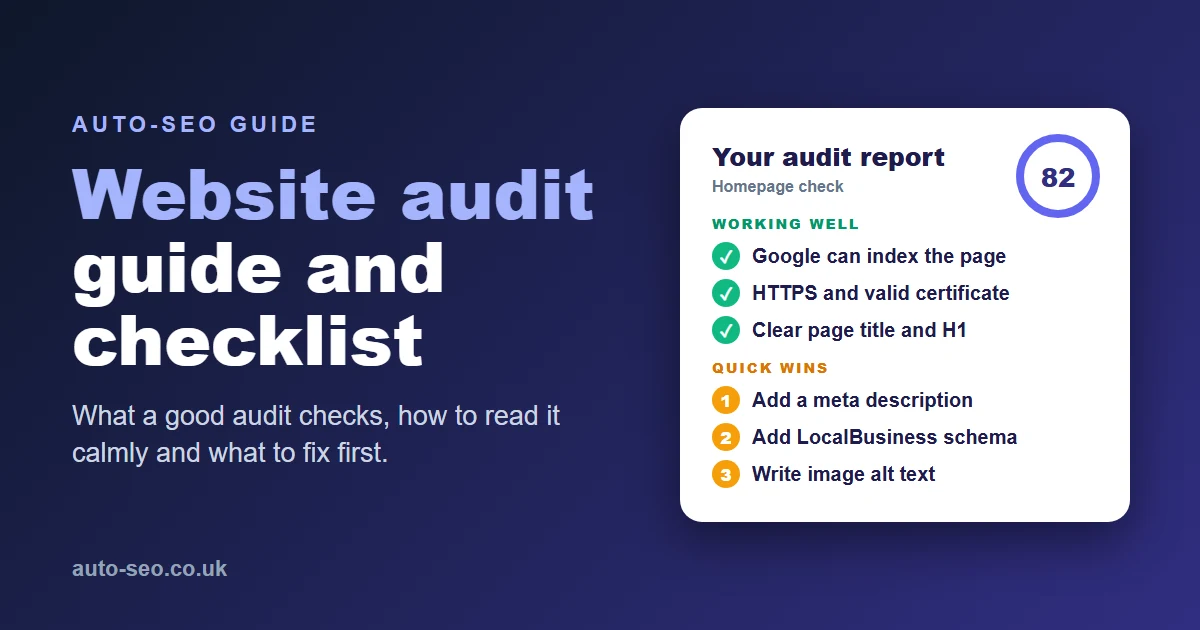
Not sure where your site stands? Our website audit checklist walks you through it step by step.
AI search visibility: mentions are the new links
This is the newest list in the survey, and the most different. The report sums it up in one line: "In AI SEO, mentions (citations) are the new link."
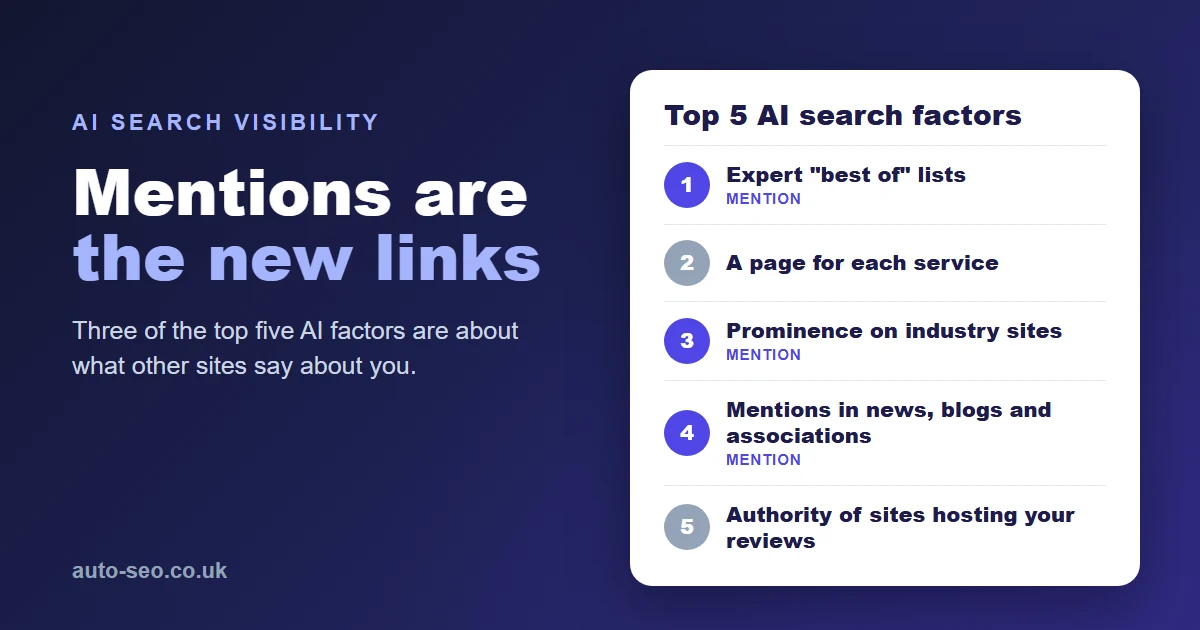
Three of the top five AI factors are about what other websites say about you, not what your own site says.
Being on expert-curated "best of" lists (179).
A dedicated page for each service (170).
Prominence on key sites in your industry (167).
Quality mentions in news, blogs, government and association sites (160).
The authority of the sites that host your reviews (156).
Further down, high Google ratings (146), reviews spread across several sites (136) and unlinked brand mentions (135) all count. Keywords in your business name matter far less here, and experts expect title and URL keywords to become "almost irrelevant for AI systems".
Our guide to getting cited by ChatGPT explains how we help businesses earn those mentions.
What to do this week: get mentioned
Ask to be listed by your trade association, suppliers and local business groups.
Collect reviews on one more site your customers already use, beyond Google.
Pitch a story to your local paper or a community website.
Update your Bing Places and Apple Business Connect listings, because AI tools draw on them.
Check your robots.txt file doesn't block AI crawlers.
What wins the click: conversion factors
Ranking is only half the job. The survey also asked which factors make a searcher choose you once they see you, and high Google ratings lead clearly (213).
High Google ratings (213).
Positive wording in review text (179).
Being close to the searcher (174).
A mobile-friendly website (174).
Google reviews with written text (173).
Being open at the time of search (171).
Recent reviews (165).
Photo and video quality (149) and owner replies to reviews (136) also feature. Good recent reviews, real photos and a site that works on a phone turn views into calls.
Our guide to the benefits of Google reviews covers why they matter so much to local customers.
What to do this week: win more clicks
Reply to every review, good or bad, within a few days.
Ask happy customers to mention the job and the area in their own words. Never write reviews for them.
Swap stock photos for recent photos of your real work.
Track calls and enquiry forms, not just website visits.
What hurts: negative factors and suspension risks
The most damaging factors are mostly mistakes, not penalties. A profile marked permanently closed (217) and the wrong primary category (214) top the list. Next comes another profile in the same category at the same address (188), which can filter one of them out of the results.
For suspensions, the biggest risk is a PO box or virtual office address (202), followed by links to a suspended Google account (194). The experts call competitor reports the number one suspension risk, so keep everything on your profile honest and accurate.
Local SEO myths the survey puts to bed
Several popular tactics scored near the bottom of the 187 factors.
Title tag length: 184th for the Maps pack. In Darren Shaw's words, "title tag length is an SEO myth".
Geo-tagged photos: close to the bottom of the list.
Social media follower counts: also close to the bottom.
Spending on Google Ads or other paid Google products: scored near the bottom for rankings.
XML sitemaps and keywords in image file details: also near the bottom.
Lots of Google Posts, or keywords in your replies to reviews: little ranking value.
The experts also corrected two common beliefs. Consistent business details across the web still matter, as "a reputation and conversion factor", and a strong website won't protect a profile that breaks Google's guidelines.
FAQs: local search ranking factors
Does Google confirm these ranking factors?
No. The survey reflects the views of 47 experts, not data from Google. Google's own help pages say local results are based mainly on relevance, distance and prominence, and the survey's findings fit within those three.
What is the most important Google Maps ranking factor?
Your primary Google Business Profile category, with a score of 227. Proximity to the searcher is a very close second at 225, but you can't change where you are.
Can I rank on Google Maps without showing my address?
Yes. If you visit customers rather than having them visit you, Google asks you to hide your address. Focus on the factors you control: your category, services, hours and a steady flow of reviews.
Do reviews on other websites help?
Yes, especially for AI search. The authority of sites hosting your reviews scores 156 and having reviews on several sites scores 136. High ratings on other sites also help people choose you.
Does posting on my Google Business Profile help?
Not much for rankings, according to the survey. Post when you have something useful to share, such as an offer or a recent job.
See where you rank today
The quickest way to use this list is to see where you stand right now. Our free local audit shows your Google Maps ranking across your area on a heat map, the competitors taking the top spots and whether ChatGPT recommends you. It takes about a minute, with no sign-up needed.
For every score and factor, see the full Local Search Ranking Factors report from Whitespark.